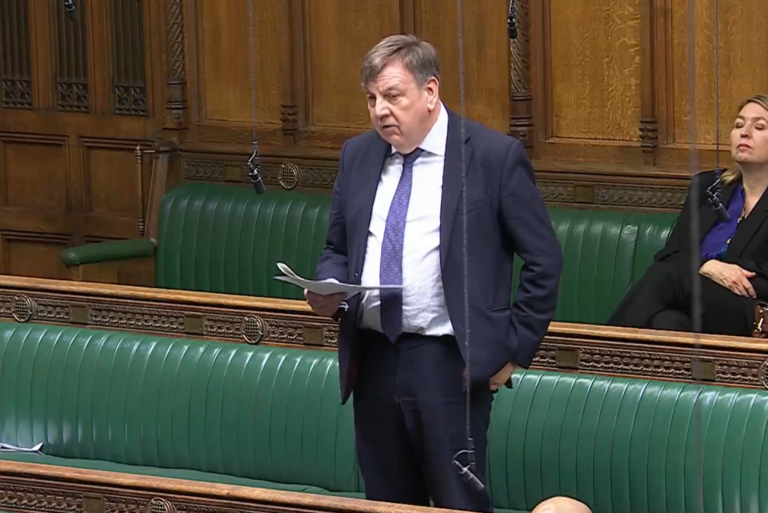
This debate examines the process surrounding the proposed appointment of Peter Mandelson, focusing on transparency, record-keeping and decision-making within government.
Sir John highlights evidence suggesting that no recorded comment or meeting by the Prime Minister exists in relation to the appointment, and presses ministers to clarify whether such records were ever created and, if not, why they are absent.
More of Sir John’s involvement to trace accountability on Peter’s Mandelson’s Appointment can be found at this post, here.
To see the whole debate, watch the YouTube video which includes a full transcript and closed captions.
Debate Highlights Transcript
Darren Jones Minister of State (Chief Secretary to the Prime Minister), Chancellor of the Duchy of Lancaster, Minister for Intergovernmental Relations
With permission, I would like to update the House on the Government’s response to the Humble Address of 4 February. Before I do, I think it is important for all of us to reflect again on the impact that this debate will have on the victims of Jeffrey Epstein. Members across the House will be aware of the truly horrific crimes that he committed against countless women and girls; we hold them in our thoughts when discussing these issues again today. The Government have today laid the second tranche of documents. These were laid before the House in advance of this statement and are now on gov.uk for the public to see. The documents we are publishing today comprise one of the largest Government publications ever laid before the House. This disclosure process has been wide-ranging, costing the Cabinet Office alone over £1 million. As the House knows, this was an official-led process, with judgments made by senior officials, and I am grateful for the careful work that they have undertaken right up until today’s publication. While the first tranche dealt with Peter Mandelson’s appointment, withdrawal and severance, this second tranche responds to the parts of the motion that requested communications and documents concerning his appointment and vetting, as well as messages between Peter Mandelson and Ministers, special advisers and civil servants in the months prior to, and throughout the duration of, his appointment. I recognise that the House will need sufficient time to review today’s tranche in full, given the size of the publication. As we have just heard from the Leader of the House, that is why I have secured Government time on Wednesday for a subsequent general debate: so that there is an opportunity for Members to ask further questions after today’s statement. To inform that debate and for clarity and accountability, I draw the House’s attention to the methodology set out in the publication today, which explains in detail how the Government undertook the disclosure process. I will not repeat that in full here today, but I will make reference to a number of areas that I know the House has expressed an interest in previously. First, on redactions, in line with the motion, over 300 individual documents were referred under a process agreed between the Government and the Intelligence and Security Committee. I confirm that no material has been redacted on the grounds of prejudice to national security or international relations without the Committee’s approval. For clarity, all redacted material agreed with the ISC is labelled in the bundles today with three asterisks. Outside this arrangement, this process does not change the important and well-established constitutional principle that national security and international relations judgments are ultimately for the Government. I once again express my thanks to the Intelligence and Security Committee for its engagement in this process. Further limited redactions have been made outside the ISC process in respect of information that relates to junior officials’ names; contact details, like telephone numbers and email addresses; the personal or commercially sensitive data of third parties not relevant to the motion; and, where relevant, legal professional privilege. I would also like to confirm that no redactions have been made to references to Global Counsel, other than to protect the identity of individuals who worked there and are not public figures. Officials have sought to be transparent in the material where the individual is a Global Counsel employee. Also, no redactions have been made to references to Palantir and Anduril outside the scope of the existing ISC redactions process, and no clear references to current or former UK politicians have been redacted on the basis of their being third parties. I can also confirm to the House that no Government Minister or special adviser has determined any of the redactions themselves. The redaction process has been overseen by Cabinet Office officials and, where relevant, in agreement with the ISC. In addition, the Cabinet Office Humble Address team have taken advice from an independent King’s Counsel—this has included review of the methodological approach followed by officials—and acted on that advice to inform their work. This has helped to ensure that the Government are confident that their approach is compliant with the Humble Address and the Government’s legal obligations. These additional targeted redactions, made outside the agreed ISC process, have been made in line with the Freedom of Information Act 2000, the ministerial code, and the resolutions on ministerial accountability passed by both Houses in 1997. This is important because it goes to the question of whether the Government have complied fully with the Humble Address. That question should be answered in the context of the established rules and precedents that relate to Humble Addresses. If these rules were not relevant, the Humble Address would have required extensive additional detail on the face of the motion dealing with these procedural issues. However, I recognise the level of interest in the House in respect of these redactions not related to national security and international relations, so, on the recommendation of the ISC, I can confirm that Simon Hoare, the Chair of the Public Administration and Constitutional Affairs Committee, has reviewed our approach to third-party redactions this morning. He has confirmed that we have applied the methodology set out in the document and that, in his view, the redactions are sensible, reasonable and proportionate. I thank the ISC for this recommendation and the hon. Member for the additional reassurance he has provided on this point. As the House is aware, the Metropolitan police has also asked the Government to withhold some material in scope of the motion that it considered could be prejudicial to its ongoing criminal investigation or any subsequent prosecution. This request remains in place and I am very grateful, again, to the Chair of the Public Administration and Constitutional Affairs Committee, with whom we have also shared this information in order to provide additional accountability for the Government’s actions. I hope that Members will appreciate the need not to prejudice the investigation and understand that I will not be able to answer questions about certain documents that have been withheld. No responsible Government would wish to undermine a criminal investigation and put at risk the justice that it seeks, and I am sure that the House will share this position. I can, however, confirm that this material does include questions put to Peter Mandelson by the Prime Minister’s then chief of staff, and Peter Mandelson’s responses. In addition, a small number of documents have been withheld at the request of the police, which fall broadly into the following categories: national security vetting material; conflict of interest process material; and relevant internal correspondence with Peter Mandelson. Such information will, of course, be published at the conclusion of the investigation or at the point at which it would no longer be prejudicial to the police investigation to do so. The documents published in the first and second tranches contain the entirety of the documents the Government have available for disclosure, except those few documents I have just referred to in relation to the Metropolitan police. Members will no doubt have questions about what might be perceived to be “missing” messages and meeting notes, which I would like to address in turn. On messages that some might expect to be included, I can confirm that we have conducted multiple rounds of discovery from relevant Ministers, special advisers and officials, in line with the motion passed by the House. This has involved requesting searches of email, messaging platforms such as WhatsApp, and other related communications services on both work and personal devices. However, the House should note that some messages may not have been backed up where devices may have been changed or disappearing messages turned on, for reasonable and permitted reasons, including before the dismissal of Peter Mandelson or the passing of the Humble Address—my messages included. I do recall having some limited exchanges with Peter Mandelson over WhatsApp, including those I have already discussed in the media, but these conversations did not involve transacting Government business and were in line with official guidance on the use of non-corporate communications channels at the time. I share the view put by the Intelligence and Security Committee to the House that there are lessons for the civil service to learn in respect of better note-keeping, archiving and the use of appropriate levels of secure IT systems in the future. The Government have already committed to a review of the use of non-corporate communications channels, the terms of reference for which we will shortly publish, taking into account the concerns that have been raised in this House and the two tranches of documents that we have published in response to the Humble Address. I will of course keep the House updated as we progress that work. I now turn to the material relating to Peter Mandelson’s national security vetting process. I can confirm that the vetting process summary and recommendation that was put by UK Security Vetting officials to the Foreign Office has been shared with the Intelligence and Security Committee. It was shared for the purpose of agreeing redactions, as part of the agreed process, so that it can be published when we are in a position to do so. What have not been shared are the highly sensitive personal data inputs collected during the interview process. These could, for example, relate to how much money an individual might have in a particular account or who a person may have had a personal relationship with in the past. If those participating in the vetting process cannot trust that the information they feed into that process is confidential, that will harm the integrity of the whole system. Anything less than full candour would be hugely damaging and profoundly negative for our national security; this would be felt by this and future Governments and, ultimately, by the British people. Sharing this data for any person undergoing developed vetting would therefore undermine the very basis of our national security vetting system. This is the 10th update to the House on this matter that I have provided. With the exception of the small number of documents that are withheld at the request of the police, which we intend to publish when the police are content for us to do so, the Government now consider that they have duly discharged the duties set out in the Humble Address. I will, however, return to the House for the general debate on Wednesday to provide a further opportunity for colleagues to ask questions. On that basis, I commend this statement to the House.
[…]
John Whittingdale Conservative, Maldon
“Further to the question from my right hon. Friend Sir Julian Lewis, we have seen in the first tranche the box note that was sent from the Prime Minister’s private office to the Prime Minister setting out the issues and asking whether Peter Mandelson should be appointed, but that piece of paper bears no comment. When I asked the permanent Secretary at the Cabinet Office about this, she said that she would have expected there to be a record of the Prime Minister having written a comment or held a meeting to discuss it. There is apparently no record of either. Is the Minister saying that it does not exist, and if it does not, why not?”
Darren Jones Minister of State (Chief Secretary to the Prime Minister), Chancellor of the Duchy of Lancaster, Minister for Intergovernmental Relations
The communication of the Prime Minister’s decision does exist in the first tranche, where his principal private secretary drafted a letter communicating the Prime Minister’s decision to the relevant stakeholders.