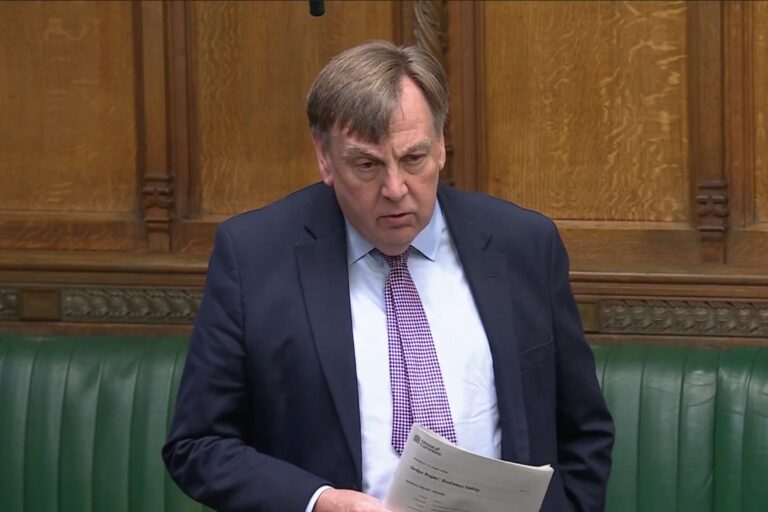
Sir John Whittingdale MP has introduced his Private Member’s Bill on SLAPPs (strategic litigation against public participation) in the House of Commons.
The Bill seeks to strengthen controls against the use of SLAPPs, which Sir John describes as an abuse of the legal system that can be used to suppress legitimate investigative journalism and restrict free expression.
In general, Private Member’s Bills allow individual MPs who are not Government Ministers to propose new legislation and raise issues they believe require further consideration. While only a small number progress into law, the process provides an opportunity for MPs to bring forward proposals, encourage debate and seek support across Parliament.
In introducing the Bill, Sir John highlighted the importance of ensuring that the legal system cannot be used to suppress public interest reporting or silence debate. The legislation reflects his focus on strengthening protections around free expression and tackling what he describes as an abuse of the legal process.
This Bill will now progress through the parliamentary process, with further stages including debate and consideration by MPs. Updates will be shared on this page as the Bill develops and as discussions continue in Parliament.
Introducing the Bill - 17th June 2026
Introducing the Bill at its First Reading, Sir John said: “Today, I introduced my private members’ bill on SLAPPs (strategic litigation against public participation) to the House of Commons. I am delighted to have this opportunity to try and strengthen controls against SLAPPs. They represent an abuse of the legal system and, for too long, have been used by the rich and powerful to suppress legitimate investigative journalism and to muzzle free expression.”
Outlining the Bill - 1st September 2026
At the Bill’s Second Reading where its key principles were outlined, Sir John drew on his experience as Chair of the All-Party Parliamentary Group on Media Freedom and his previous work on libel law to highlight the continuing threat posed by Strategic Lawsuits Against Public Participation (SLAPPs). He outlined the limitations of existing protections, including those introduced through the Economic Crime and Corporate Transparency Act 2023, and explained his intention to build on previous parliamentary efforts with a Private Member’s Bill to introduce broader protections. Sir John emphasised that legitimate defamation actions must remain protected, while arguing that the deliberate use of litigation to suppress information in the public interest should not be allowed. He also welcomed the opportunity to work with the Government and colleagues across Parliament to develop effective legislation that protects freedom of speech and journalism.
After thanking Alex Sobel on securing the debate, Sir John said: “[This] is a subject that we have discussed in this place a number of times over the years, and each time the need for action becomes even greater.
I speak in my capacity as chair of the all-party parliamentary group on media freedom, and also, as the hon. Member for Leeds Central and Headingley said, as the sponsor of a private Member’s Bill, which I shall introduce in November. SLAPPs have been a stain on this country’s reputation as a defender of media freedom for too long. We actually set up the Media Freedom Coalition in 2019, and I am delighted that under the outgoing Foreign Secretary, Yvette Cooper, the UK has taken back the co-chair position with Finland.
The UK’s position on media freedom is one that we can be proud of. We have gone up in the world press freedom index ranking—we are now 18th—but in its commentary on the UK, RSF said “lawsuits aimed at gagging journalists” are one reason why we are not in a higher position.
SLAPPs are not new; they have been around for a long time. I spent part of my summer in my deckchair, reading an excellent book by David Hooper that recounts the history of SLAPPs, starting with James Goldsmith and his war on Private Eye, followed by Robert Maxwell, who took on Aurum Press and the biography written about him, and then, perhaps most notoriously, Mohamed al-Fayed, whose appalling actions in abusing young employees at Harrods were known about and reported on, but then suppressed as a result of the lawsuits that he sprayed around liberally, using very expensive lawyers.
It is generally the case that SLAPPs are used by rich people seeking to suppress information that is clearly in the public interest. When I chaired the Culture, Media and Sport Committee, now 15 years ago, we looked at the advent of libel tourism—the fact that the UK courts were specifically being used by people with very little connection with the UK to bring libel suits, because we were seen to be sympathetic to the idea of libel actions, in order to suppress information. Since then, Russian oligarchs in particular have queued up to come and use the British courts. As the hon. Member for Leeds Central and Headingley said, we have talked to and met some of the brave people who have sought to expose those oligarchs’ actions and have been subjected to SLAPP cases—people like Catherine Belton, the author of “Putin’s People”, and Tom Burgis, the author of “Kleptopia”. It continues today. I am not going to go into a number of cases; we will perhaps have more opportunity to do so when the private Member’s Bill comes forward. However, I am particularly grateful to the Anti-SLAPP Coalition for its help in taking forward this campaign.
Progress has been made: the Defamation Act 2013 sought to address some of the worst aspects of libel tourism, and the Economic Crime and Corporate Transparency Act 2023 focused specifically on those who are alleging economic crime, and it put in place some protection. However, the problem is that some of the worst cases—I go back to the work of both Catherine Belton and Tom Burgis—were not allegations of economic crime, but were more serious than that. Clearly, the provisions in that Act would not have been sufficient. In the previous Parliament, Wayne David sought to extend its provisions to cover a far wider range of actions, but sadly his private Member’s Bill did not complete its passage due to the calling of the General Election. My intention is to try to complete the work that Wayne David started with his Bill.
As the Minister will be very much aware, at the beginning of this year, 120 editors—including the editors of every major publication not just in the UK, but across the world—called on the Government to act. I know that the Government were committed to taking action, but unfortunately could not find a slot to do so. I am extremely grateful to the Minister for the discussions that we have already had about how we might work together to bring that legislation on to the statute book.
The hon. Member for Leeds Central and Headingley is right that Baroness Stowell has introduced a private Member’s Bill in the other place. Her Bill has been published. There is some debate as to the mechanism that is most effective; there were concerns that the attempt in Wayne David’s Bill to set out lengthy definitions might make it more complex, and there is an argument for trying to make the test of a SLAPP simpler. Those are details that we will want to continue to discuss with the Minister and her officials. For my part, I very much hope that we can find an agreement that all of us are happy with and that will achieve the objective we all share.
I should say that I am not opposed to people having the right to bring defamation actions or other suits where they feel that they have been wrongly accused of something—that is a fundamental right. What I am opposed to is the abuse of lawsuits with the deliberate intent of suppressing information that is clearly in the public interest. It is that definition that we will seek to explore how best to set out in legislation.
I look forward to further meetings with the Minister. I welcome this as perhaps the first opportunity to debate what I believe is a very important issue for the freedom of speech and journalism in this country.”