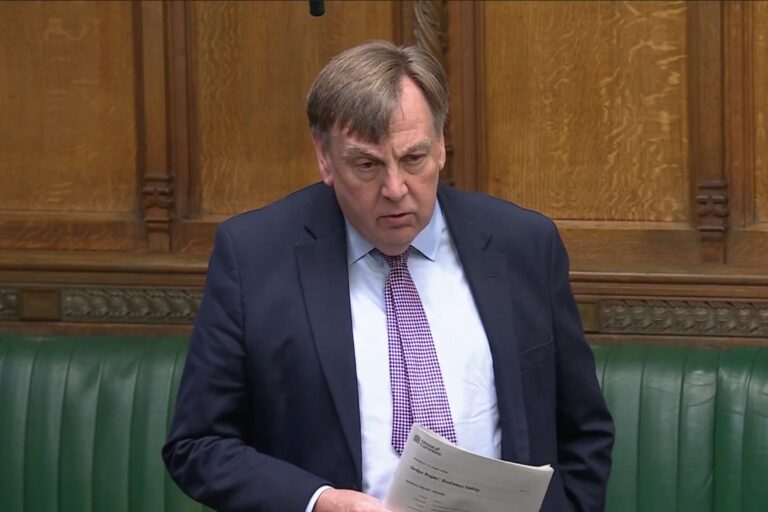
Sir John chaired the House of Commons debate on the Media Green Paper, welcoming the proposed transition from digital terrestrial television while highlighting concerns over broadband access and the impact on commercial radio.
He also questioned proposals to give greater prominence to trusted news providers on video-sharing platforms and social media, warning against increased Government interference in freedom of the press and free speech.
Debate Highlights
John Whittingdale Conservative, Maldon
I beg to move,
That this House
has considered the Media green paper.
It is a pleasure to serve under your chairmanship, Dr Allin-Khan. I am grateful for this opportunity to debate the media Green Paper, a hugely consequential document that has profound implications for all our broadcasters, news publishers and technology companies. I welcome a lot that is contained within it. Nevertheless, it contains some extremely controversial proposals, and I regret that Parliament has not really had an opportunity to debate them since its publication. The consultation period has now come to an end, so I hope that the Minister will still take account of my contribution and those of other Members when considering the way forward. It is also regrettable that we have only an hour. I will try to keep my speech brief, because quite a few Members have made the effort to attend.
I will focus on two issues that are perhaps the most controversial in the Green Paper. On the first—the suggestion that in 2034 we should move towards wholly internet protocol TV and discontinue digital terrestrial transition—I am generally supportive of the Government. There are clear benefits to doing so. It will represent a considerable cost saving to the broadcasters, as outlined in the Green Paper. Secondly, it will free up spectrum, for which there could be any number of alternative uses, and that will undoubtedly provide additional value to consumers. The third reason I welcome it is that it opens up an option on the other big issue, which is the subject of a different Green Paper and is perhaps the elephant in the room: the future of the BBC. The biggest argument against moving towards an element of subscription, at least, in the BBC is that that cannot be done while the BBC is subject to digital terrestrial transmission.
Alec Shelbrooke Conservative, Wetherby and Easingwold
I just want to pick up something, because I have not studied the proposal to turn off the digital Freeview signal in enough detail. Every house would need an internet supply, so would that supply be provided free or would people have to subscribe to get it in?
John Whittingdale Conservative, Maldon
My right hon. Friend asks a perfectly valid question, and I want to acknowledge that there are concerns. We had a debate in Westminster Hall not that long ago, and a number of my colleagues—particularly from Scotland—turned up to express concern about the fact that the quality of reception via broadband in their constituencies is very poor and that the consequence of switching off DTT might be to prevent them from receiving television at all. That is clearly unacceptable. The proposal can go ahead only if we reach the position to which the Labour and Conservative Governments have aspired: universal access to high-speed broadband of sufficient quality to allow IPTV to be received.
Chris Kane Labour, Stirling and Strathallan
I am concerned about the impact of the switch-off on commercial radio. The BBC may be able to absorb some of the consequences of the DTT switch-off, given the savings that it will make from its television distribution, but commercial broadcasters do not have the same offsetting saving. Does the right hon. Gentleman agree that the Government should therefore consider how to ensure that commercial radio is not the unintended loser in a reform designed principally around television?
John Whittingdale Conservative, Maldon
I strongly agree, and that is the point that I was coming to next. A lot of the towers in the transmission network, which broadcasts digital terrestrial transmission, are owned by Arqiva, and they also carry the transmitters for commercial radio. The hon. Gentleman is absolutely right that if we turn off the television transmission, all the costs get loaded on to the remaining broadcasters—that is, the commercial radio stations. I therefore hope that the Minister will at least address that too, because the estimate that I saw is that it will potentially result in an increase in costs of more than 50% a year for commercial radio stations.
Jim Shannon DUP, Strangford
One aspect of the media green paper for us in Northern Ireland is similar to the position in the rest of the United Kingdom, in that it will directly threaten not only our local broadcasting sector but the connectivity of our rural and most vulnerable communities. The 2034 switch-off of digital terrestrial TV is focused almost entirely on what appears on our television screens, but the real casualty is commercial and local radio. The right hon. Gentleman is right to underline the issue. The economic modelling shows that transmission costs will surge by almost 50% per year for commercial radio. Does he agree that that will be the death of commercial radio?
John Whittingdale Conservative, Maldon
The hon. Member is completely right that this issue must be addressed before we proceed. There is also the question of cost, raised by my right hon. Friend Sir Alec Shelbrooke. There are people who probably do have access to broadband, if they choose to pay for it, but they cannot afford to do so. They, too, would be severely affected if they were suddenly unable to receive television by that means. I support the ambition to reach a point in 2034 when we will be able to switch off DTT, but serious questions need to be addressed before we reach that point.
I will turn to the other major issue of twofold concern, because the Government are advancing two parallel policies on the question of prominence. I was the Minister responsible for the passage of the Media Act 2024, during the previous Parliament. It is a great delight to see some familiar faces with whom I have worked with in the past on the officials’ Bench. The Media Act was all about ensuring that our public service broadcasters were still highly visible in a world where people are getting smart, connected TVs. It simply maintained the prominence requirements, which was important, as all the broadcasters agreed.
It is now suggested that the same prominence should be extended to video-sharing platforms. I recognise and agree with the Government’s concern about the prominence of disinformation. I sit on the Foreign Affairs Committee, which did a big inquiry into disinformation. The best counter to disinformation is accurate, sourced, objective journalistic content, of the kind that public service broadcasters provide. Nevertheless, YouTube, the main video-sharing platform under discussion, was never intended as the vehicle for the big broadcasters. It is all about user-generated content. There is real concern that if the main broadcasters are pushed into greater prominence, some people will get less prominence. Those are the creators, start-ups and user-generated content. That undermines one of the original purposes of YouTube.
Peter Fortune Shadow Parliamentary Under Secretary (Business, Innovation, Science and Tarde)
I want to come in on the matter of trust. One of the most trusted media or news sources is local media, with 42 million readers a week. I never miss an opportunity to say that the News Shopper is great. Does my right hon. Friend think that this is an opportunity for the BBC, which has done some great work with the local democracy reporting service, to enhance its effective work with local media so that we do not lose that trusted local news source?
John Whittingdale Conservative, Maldon
As one of the originators of the local democracy reporting service, of course I agree with my hon. Friend. It is incredibly important to have a thriving local media sector, and the BBC plays an important role in maintaining that. Anything that promotes BBC content would, I hope, equally promote local content, which has not had the same degree of attention that it deserves.
Lisa Smart Liberal Democrat Spokesperson (Cabinet Office)
I am interested in the right hon. Gentleman’s views about prominence. How does he see his view sitting alongside reducing the voting age to 16 by the end of this Parliament, almost certainly in time for the next General Election? Young people do not get much of their information from linear broadcast channels. They get a lot of it from places such as YouTube. How does he reconcile his views on prominence? In my opinion, it is a necessary but not sufficient way to get good, trusted media to young people to equip them to vote.
John Whittingdale Conservative, Maldon
That is perhaps even more relevant to the second prong of the Government’s proposals, which is about social media. I will come to that point, but before I finish talking about local media, I want to mention that another of the Government’s flagship policies is devolution. If we are to have more power given to local authorities, mayors and unitary authorities, people need to know what they are doing, and the absence of local media is a real problem in that respect. It will become ever more important to promote local media.
Lastly, I want to come to the second prong, which is about the prominence or promotion of trusted news providers on social media. I have to say that this policy gives me some considerable concern. There are lots of problems around definition. First, what is news? Secondly, what does “prominence” mean for a social media platform on which people access a personalised feed based on their previous content choices? There are practical difficulties with that.
I know the Government have already put in place the concept of recognised news publishers under the Online Safety Act 2023, but that had a very different purpose. The problem I have is with the idea that a Government agency of some kind will be saying, “This is a trusted news provider, and therefore this is not,” and deciding, or at least seeking to influence, where those providers appear in people’s feeds. I take the point from Lisa Smart that young people are turning more and more to social media, but I do not think that this policy is the answer, because it looks to me like a very dangerous extension of Government interference in the freedom of the press and the right to free speech. I would like the Minister’s assurance that there is no linkage intended to any form of regulation. The idea that perhaps news providers might be given prominence if they accept a regulatory structure that the Government want would be equally dangerous.
In some ways, I think that this problem is better addressed by the measures that we have already put in place. We have the digital markets competition regime, which is only just coming into effect. The Competition and Markets Authority could be doing much more to require the platforms to make public the algorithms they use to promote content. Before we go down that road, which carries real jeopardy, I hope that we will look instead to use some other measures that have already been put in place to ensure that reputable news providers get the position that they deserve in search terms and search, and also the rewards attached to them.
[…]
John Whittingdale Conservative, Maldon
I thank all hon. Members who have participated in the debate. The number of Members present indicates that this is a subject that deserved more than an hour; I welcome the Minister’s recognition of that point and his suggestion that there may be further opportunities to come.
I am grateful to have had the opportunity to put on the record some points about which I have concerns. I look forward to the Government’s coming forward with further proposals once the consultation has been considered.
Question put and agreed to.
Resolved,
That this House
has considered the Media green paper.
Sitting adjourned.”