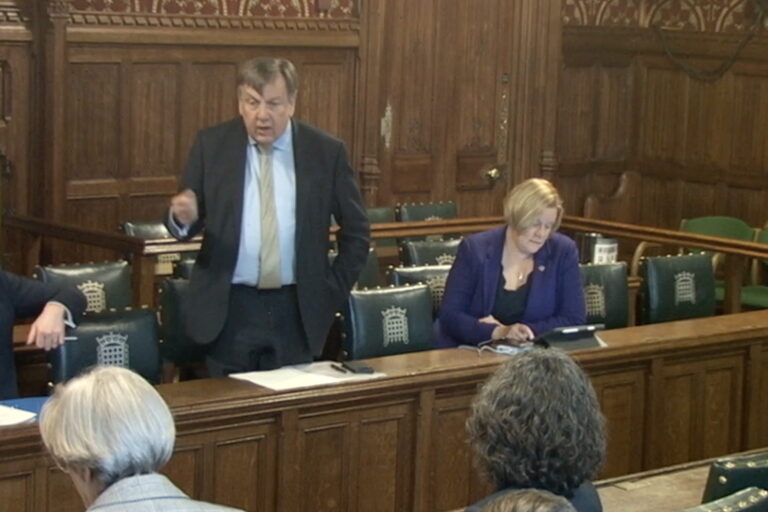
In this Committee session, Sir John raises concerns about the impact of business rates changes on high street firms, drawing on recent conversations with pubs and other Maldon businesses. He questions the pace and clarity of the Government’s approach, highlighting the uncertainty facing local employers and the need for more practical support as they adjust.
Session Highlights
Samantha Dixon The Parliamentary Under-Secretary of State for Housing, Communities and Local Government
I beg to move, that the Committee has considered the draft Non-Domestic Rating (Chargeable Amounts) (England) Regulations 2026.
It is a pleasure to serve under your chairship for the first time, Mr Turner.
On 1 April 2026, business rates bills will change as a result of the 2026 revaluation of all rateable values. The draft regulations will deliver a transitional relief scheme to gradually phase in bill increases resulting from the revaluation over three years. They will also deliver a 1p transitional relief supplement, in 2026-27 only, to help fund the cost of the support scheme.
I want to be clear to the Committee that the transitional relief scheme we are discussing is only one part of the support package announced by the Chancellor at the Budget in November. The transitional relief scheme by design only protects ratepayers from changes in their rates bills before other reliefs. As we know, changes in other rate reliefs can occur at the revaluation, which also affects rates bills. An obvious example is the ending of the covid-era 40% relief for retail, hospitality and leisure, which helped many businesses recover from covid over recent years.
That is why we also have in place the supporting small business relief scheme, which provides further support beyond transitional relief for those ratepayers who, at the revaluation, will lose certain other reliefs, including the 40% retail, hospitality and leisure relief. The supporting small business relief scheme is delivered by guidance rather than regulations, and the full details of the scheme were published in early December.
It would be remiss of me not to acknowledge the concerns raised by the pub sector in recent weeks. As hon. Members will be aware, the Chancellor is looking at what more we can do to support pubs, and further work is under way. The details of that will be announced in the coming days. These further interventions are not formally part of today’s debate, but they are important context: as we consider the draft regulations, we must remember that they are only part of the picture. When taken together, our overall support package will ensure that most properties seeing bill increases will see them capped at 15% or less next year, or £800 for the smallest properties.
As hon. Members will be aware, revaluations are an important and necessary part of the business rates scheme. At revaluations, the rateable value—the estimated annual rental cost—of all 2 million non-domestic properties is uprated to reflect market conditions. At the same time, the multipliers—or tax rates—are adjusted in response to the overall movement in the tax base. To put it simply, if the overall total of rateable value increases at the revaluation, it has a downward pressure on the tax rates, and vice versa. That is why the multipliers for next year will be at a lower rate than they are currently. The new rateable values, which were published by the Valuation Office Agency in draft in November, will be applied from 1 April.
The nature of revaluations means that some ratepayers’ bills will go up, some will stay the same, and of course some will go down. The Government know that, and we know that support is required to help some of those ratepayers seeing increases to move gradually to their new liability over time. That is why we have introduced the generous support package to help ratepayers with their new liability over three years, at the centre of which is the transitional relief scheme we are discussing today.
The transitional relief scheme that the draft regulations will deliver will provide support to around half a million ratepayers that will see their bills rise substantially as a result of the 2026 business rates revaluation. That support will be provided over three years, and is worth about £3.2 billion.
The scheme will cap bill increases that arise due to the revaluation by a set percentage each year; for example, in the first year of the revaluation, 2026-27, the caps in the transitional relief scheme are 5% for small properties, 15% for medium properties and 30% for large properties. The caps are before changes in other reliefs and local supplements, such as the Crossrail supplement charged in London, so changes in actual bills may differ from the caps. As I have said, we have provided further support for properties losing certain other reliefs, such as the current 40% retail, hospitality and leisure relief.
For this revaluation, the transitional relief scheme will provide more generous caps for large properties in years 2 and 3, compared with previous revaluations. The caps will also rise with inflation in 2027-28 and 2028-29, as has been the case previously. Of course, ratepayers’ bills may also change for other reasons, unrelated to the revaluation—for example, if the property has been improved.
At the Budget, the Chancellor announced that to help fund the cost of the transitional relief scheme, the Government would introduce a 1p transitional relief supplement. This will only apply for one year, from 1 April 2026. The impact of the supplement will add only 2% to 3% to the bills of affected ratepayers in 2026-27.
As I have said, it is important to note that the precise increase in bills next year, and in the future years of this rating list, will vary depending on the individual circumstances of each ratepayer and, in later years, on inflation. However, the caps will ensure that large increases are moderated, so that ratepayers have time to adjust to their new bills, as opposed to seeing a very large increase overnight on 1 April 2026. Transitional relief is calculated and applied automatically by local government; ratepayers do not have to contact their local authority to apply for it.
Revaluations are an important and necessary part of the business rates system. By ensuring that rateable values are updated in line with recent market values, we ensure that the burden of business rates is fairly distributed across the tax base in line with market conditions. Equally, we recognise that a large overnight change in their rates bill can be challenging for some businesses. That is why, at the Budget, the Chancellor announced a generous support package worth £4.3 billion, which includes protection to help ratepayers to transition to their new bill, with further support for pubs to be detailed in the coming days. The draft regulations will help to deliver that important support package by implementing the transitional relief scheme, and I commend them to the Committee.
[…]
Sir John Whittingdale Conservative, Maldon:
I do not want to repeat the excellent points made by my hon. Friend the Member for Ruislip, Northwood and Pinner, but I have listened carefully to the Minister and I have to say that essentially, this measure is a sticking-plaster over a gaping wound. It is of course the case that specific relief was provided during covid and that was going to come to an end, but it did not have to be removed in its entirety overnight. It is that decision, which is a choice being made by the Government, that has inflicted these enormous rates bill increases on many businesses right across the country, particularly on the high street.
I have been contacted by many of the pubs in my constituency and they have raised concerns about not just the impact of these existing measures, but the Government’s promise that there is some relief coming over the horizon, because it is extremely unclear what that will be. As one example, the pub I visited last weekend had rooms upstairs, so does it qualify as a hotel or a pub, and to what extent is the relief package going to benefit it? Those influences are having a real impact and affecting businesses’ decision about whether they can continue to trade. It is simply not good enough for the Government to say, “Well, in due course we’ll get round to telling them.”
It is not just pubs; I hear the Minister talking about relief coming for pubs, but as my hon. Friend the Member for Ruislip, Northwood and Pinner said, many other kinds of businesses are equally impacted. I am a patron of the Music Venue Trust, which represents grassroots music venues across the country. As I raised with the Exchequer Secretary to the Treasury in the Chamber earlier this week, some of them have not paid rates before and are suddenly facing bills, and others are seeing enormous increases. As the MVT said in its statement on the measures, these are not bills but “closure notices”—these venues will simply not survive.
I take the point made by the hon. Member for Crawley that the measure that we are debating will provide some small relief but it is simply not enough. It is not going to address the real issues that are affecting businesses. I hope the Minister will press her colleagues to introduce those measures and tell us a little more because at the moment there is total uncertainty for businesses and their future.
[…]
The Chair
It seems that the Committee may divide on the draft regulations, so let us be clear on what we are discussing. The motion being debated is that the Committee has considered the instrument; it is not a motion to approve the instrument. The House will decide whether to pass a motion to approve the instrument, if such a motion is put before it.
The committee divided 11 Ayes and 4 Noes. The question is accordingly agreed to.
Sir John Whittingdale voted No.