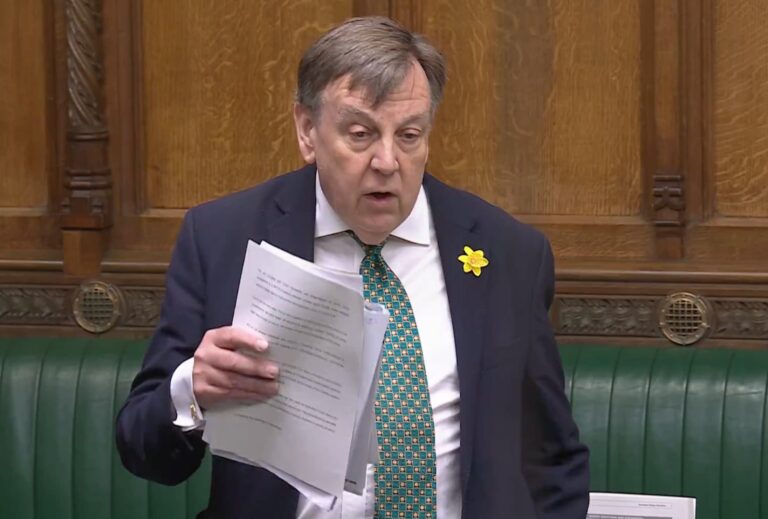
Sir John took part in a Parliamentary debate on 4 March 2026, which focused on the UK Government’s proposed cuts to the Foreign, Commonwealth and Development Office (FCDO) budget. The discussion explored the implications for Britain’s international influence, the nation’s diplomatic reach, and the support of key global institutions.
During the debate, Sir John emphasised the importance of maintaining strong funding for the FCDO to protect Britain’s soft power, highlighting institutions such as the BBC World Service and the British Council. He argued that these organisations play a vital role in projecting the UK’s values and influence abroad. Sir John also stressed the need for balanced support for defence and international development to ensure the UK remains a global leader.
His contribution underscored a commitment to sustaining the UK’s diplomatic capabilities and cultural influence while urging the Government to carefully consider the long-term consequences of budget reductions.
Debate Highlights:
Sarah Champion, Chair:
I thank the Backbench Business Committee for granting a debate on this topic, which takes place at such a crucial time for the Foreign, Commonwealth and Development Office. I also take this opportunity to thank FCDO staff for their ongoing efforts to support British nationals caught up in the conflict in the middle east.
Over successive Governments, we have seen a sustained reduction in the United Kingdom’s development budget, ODA—official development assistance. First we saw the cut from 0.7% to 0.5% of GNI, and there is now a stated path towards 0.3% by 2027. It has also been reported that the UK’s international climate finance commitment is now to be slashed by £2.6 billion. Those cuts have consequences: they affect how the UK is perceived internationally, as well as our ability to support stability and prosperity, both overseas and in our own country.
Aid has always been a highly cost-effective way of preventing conflict and reducing pressures that eventually reach our own borders. It allows girls to be educated, women to work, farmers to feed their communities, and disease to be challenged and contained. It also allows civil society to hold Governments to account. It is our soft superpower, and its benefits must not be underestimated.
The FCDO, as the past weekend proved, is constantly dealing with fast-shifting geopolitical sands. In this current financial year, as part of the FCDO’s supplementary estimate, we see further cuts to both day-to-day and investment spending, both of which have reduced quite dramatically—day-to-day spending by £457 million, and investment spending by £228 million. Most of these cuts are focused on the ODA budget, although Parliament has not yet been provided with details showing exactly where these reductions will fall.
[…]
Sir John Whittingdale Conservative, Maldon:
I am very grateful for the opportunity to debate the future spending of the Foreign Office. The Foreign Affairs Committee, which I sit on, shares the concern expressed by Sarah Champion about the impact of the settlement, which will result in significant reductions in headcount within the Department. We have tried in vain to discover exactly how that will impact on its different activities, but at a time when the world is becoming an ever more dangerous place and when the need for British diplomacy and soft power is increasing, it seems utterly extraordinary that we should be cutting back spending on the Foreign Office.
I fully support the Government’s ambition to increase spending on defence—indeed, I press them to go further—but soft power is as important as hard power. That is the area in which this country has built an extraordinary reputation for effectiveness, yet we are potentially going to cut it back exactly when it is needed most. Will the Minister say specifically what the future is of the Soft Power Council, which was set up by the previous Foreign Secretary and was something I strongly welcomed? The Foreign Affairs Committee took evidence about the work of that council, but it has gone very quiet in recent months, and I hear disturbing rumours that it is no longer regarded as a priority by the Department. I hope that in his response, the Minister will be able to assure me that that is not the case.
I want to touch on three areas of Foreign Office funding. The first, which was mentioned by the hon. Member for Rotherham, is the BBC World Service. The need for reliable, trusted information around the world is greater than ever before, yet we are seeing America withdraw from that. Voice of America, Radio Free Europe and Radio Free Asia have all been cut right back, leaving a gap that I was told this morning is being filled by Russia and China. That makes the BBC World Service even more important as virtually the sole reliable source to which people can turn, yet I understand that it has still not been told how much money it will get in 2026-27. I was allowed to attend the Public Accounts Committee a few weeks ago when the director general of the BBC and the director of the World Service told us of the impossibility of planning ahead in such circumstances. Here we are, just a few weeks before the beginning of the financial year, and they still have not been told. I ask the Minister to confirm whether the BBC World Service can find out how much it will get, and I also press him to increase that money.
Originally, the BBC World Service was told that it should plan for a real-terms freeze or a possible cash cut. That comes at the same time as the licence fee is under pressure and the BBC is reducing its contributions to the World Service through the licence fee. So the World Service is subject to a double squeeze. I have considerable sympathy for the World Service, but the right mechanism of funding is through the Foreign Office, and I support the BBC’s request that the Government consider returning to the position of the World Service being fully funded by the Government.
Secondly, I want to touch on the British Council, which we know faces huge challenges, principally as a result of the loan that was advanced to it during the time of covid. Unlike many other organisations that were given loans and not required to repay them, the British Council is being required to repay the loan even though it appears to have almost no prospect of being able to do so. At the moment, the British Council’s outgoings are greater than its income, so it cannot pay the loan and nor is it viable.
I thank the Minister for the briefing that I and the Chair of the Foreign Affairs Committee have been given about the future of the British Council, and I urge him to press ahead with drawing up a plan that will both meet the existing challenges and set out a route forward that will put the British Council on a firm footing. It does incredibly important work, especially in those parts of the world where malign forces seek to influence democratic elections and people’s attitudes.
Calvin Bailey Labour, Leyton and Wanstead:
The right hon. Gentleman makes a powerful point about the British Council and the work that it does. Much of that work is required to counter malign Russian and Chinese influence. There are a number of countries that are desperate to get out of the grasp of China and would like to have greater friendship with us. To do that, they are trying to encourage a shift in the culture and how their young people engage, and that is delivered through the British Council and English language training. Does he agree that some of the value of that training is not necessarily seen directly and should perhaps be assigned to security and defence?
Sir John Whittingdale Conservative, Maldon:
The hon. Gentleman makes a fair point. He is right about the importance of the work, which is not always fully visible, including in established countries—I have a particular knowledge of and interest in the Baltic nations, which are on the frontline against Russia. Latvia especially has a Russian minority population that is subject to a constant barrage of attempts by Russia to influence it. That is an area where the British Council is very active, and I am concerned by reports that it may be forced to withdraw from its activities in the Baltic nations. As the hon. Gentleman rightly says, Russia and China are active in other countries that are of huge importance strategically but at risk of tipping back into the orbit of hostile powers. The British Council can play an important part in seeking to prevent that.
Calvin Bailey Labour, Leyton and Wanstead:
That is a very good example, but there are also examples that are far from the frontline against Russia. Some of the countries in Africa actively need our help—aid and other contributions—to get away from that influence. We should actively support countries such as Gabon, which is trying to be a strong Commonwealth partner, and Mozambique, despite English not being spoken as widely there.
Sir John Whittingdale Conservative, Maldon:
I completely agree with the hon. Gentleman. Africa is of huge importance, and if ever we needed a reminder of the risk posed to the values we hold dear from hostile powers, in particular China, we had a perfect demonstration in the statement earlier today.
Thirdly, I want to touch on media freedom, which I am delighted that the Minister has specific responsibility for. I welcome the commitment he has already shown to it. The Media Freedom Coalition was established under the last Government by the then Foreign Secretary, my right hon. Friend Sir Jeremy Hunt. It is great news that the Foreign Secretary was able to announce in Munich recently that the UK will take back the chair of the coalition. It is even more important today than it was when it was set up. I hope that taking back the chair will not just be symbolic but matched by a real commitment to promoting media freedom, which is under huge threat in a wide range of countries. We have seen journalists threatened with imprisonment, harassed and, in some cases, murdered. The UK has a very important role to play in promoting media freedom and taking a lead on such things as the introduction of visas for journalists who are under threat and sanctions. I was pleased to see that we have just placed sanctions on Georgia—[Interruption.] You suggest to me that other Members wish to speak, Madam Deputy Speaker, so I will just say that I hope the Minister will be able to say more about those three areas in his response.