Skip to content

Rt Hon Sir John Whittingdale OBE MP

Primary Menu
  • Home
  • About
    • About John
    • About Maldon
  • Local News
  • Westminster News
  • Speeches
  • Campaigns
  • Contact John
  • Privacy Policy
  • Home
  • Pavement parking dangers with Guide Dogs
  • Westminster News

Pavement parking dangers with Guide Dogs

JohnWhittingdale June 20, 2018 3 min read

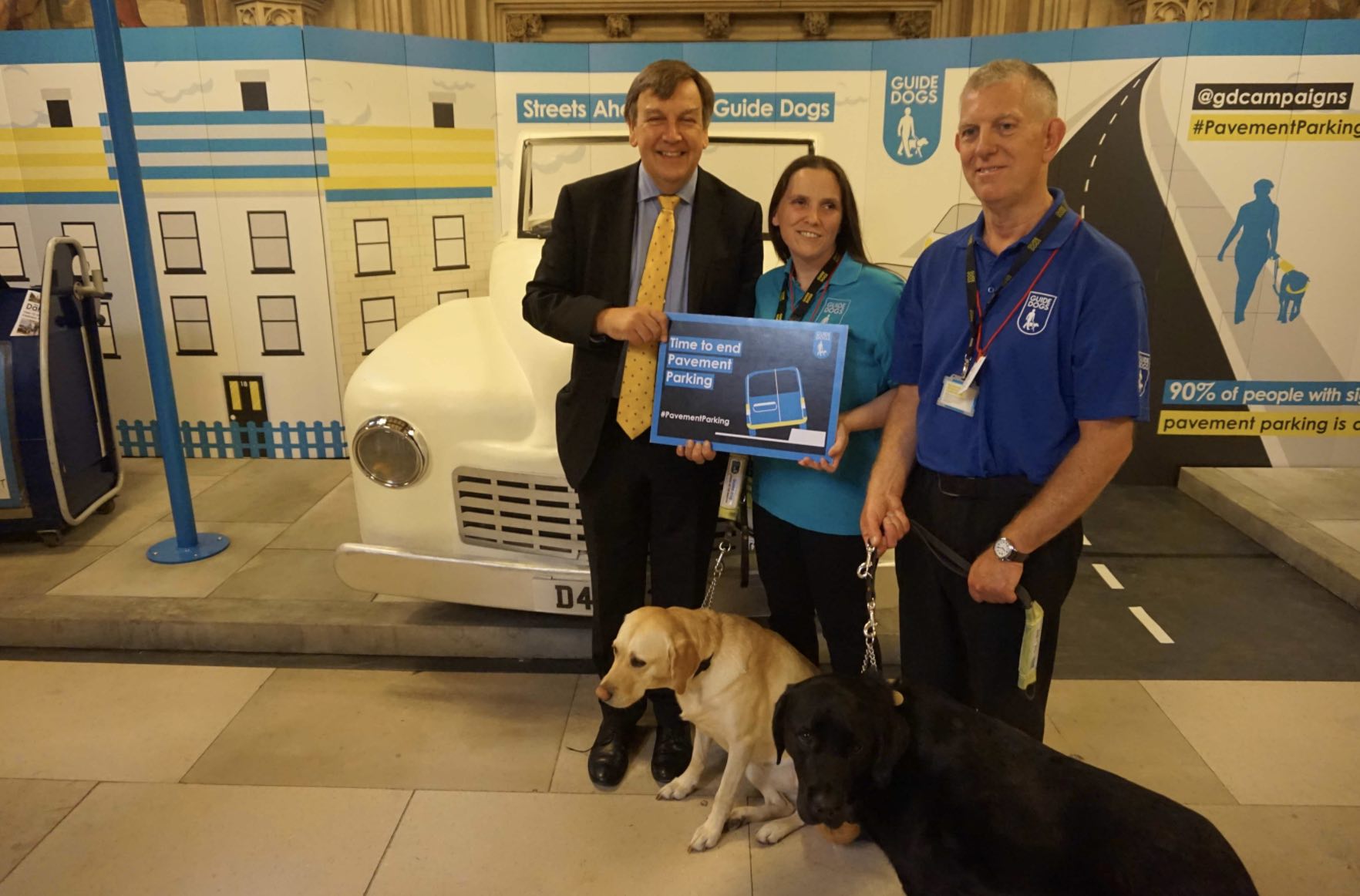
John Whittingdale MP visited a street scene set up in Parliament by the charity Guide Dogs to learn more about the challenges that people with sight loss face when walking the streets. At the event, the MP for Maldon dodged a pavement parked car, stumbled across a variety of street clutter, and visited a “shared space” area lacking safety features such as kerbs and pedestrian crossings. He also heard from guide dog owners how dealing with these obstacles can leave them scared and reluctant to go out.

According to a Guide Dogs survey, 97% of blind and partially sighted people have encountered obstacles on the pavement. The most common obstacles were cars parked on the pavement: 9 out of 10 have had problems with pavement parking. Pavement parked cars force pedestrians into the road to face oncoming traffic. This is particularly dangerous for people with vision impairments, parents with pushchairs, wheelchair users and other disabled people. In separate research by YouGov for Guide Dogs, two out of three drivers (65%) admitted having parked on the pavement and nearly half (46%) were confused by the law on pavement parking.

Guide Dogs is campaigning for a law to make pavement parking an offence, except on streets where local authorities agree that it is safe for pedestrians. This is already the case in London, but elsewhere across the country, councils struggle to tackle unsafe pavement parking.

John is pictured with  Emma and her guide dog Ivy, and Simon with his guide dog Lemar in front of a life size pavement parked car.

John said:

“I have had a number of constituents raise with me the dangers for visually-impaired and vulnerable people which result from inconsiderate parking on pavements and other obstacles.  I was interested to be able to hear about this directly at the Guide Dogs event in Westminster – including from Simon whose brother lives in Maldon. I have raised this matter with Maldon District Council in the past and would certainly support strengthening the law in this area””

Among the comments that John has received from constituents supporting the Guide Dogs campaign are:

‘Blind people and dogs matter’ Kath, Burnham On Couch

‘it severely endangers elderly, very young and blind pedestrians.’ Robert, Chelmsford

‘It can be obstructive and dangerous by forcing people to walk on the roads instead of the pavements ‘ Karen, Southminster

‘Access to paths is most important for pedestrians sighted or vi/Blind ‘ Sara, Maldon

‘it’s unnecessary, dangerous for guide dogs and pedestrians and we need to restrict cars in built up areas not encourage them’ John & Susan, Ingatestone

‘Down some roads here we have to walk in the middle of the road because cars are parked on both pavements and then the bins are blocking the rest of the footpaths and get sworn at on a regular basis. So why is the law been attractive in London for 40 years and not every else.   In London it’s illegal to park on pavements except in areas the local council chooses to allow it, for example so that ambulances can safely travel down a narrow road. The opposite is true in the rest of Great Britain, where it’s legal unless a council puts something in place for particular roads.’ David, Burnham-On-Crouch, Essex

James White, Senior Campaigns Manager at Guide Dogs, commented:

“Too often, our streets can be cluttered with dangerous obstacles for blind and partially sighted people.

The worst offenders are cars parked on the pavement. If you have a vision impairment, pavement parked cars aren’t just a nuisance, they can force you to step out into the road and put you in real danger.

Outside London, the law on pavement parking is unclear and difficult to enforce. We want pavement parking to be the exception so pedestrians can rely on their path being clear. When drivers themselves don’t know the rules, that is a strong sign the law needs to change.

Back in 2015, the Government committed to look into every option to tackle this serious problem. We hope that they will now follow up with a new law on pavement parking.” 
Continue Reading

Previous: Article for the Telegraph on Leveson and the Data Protection Bill
Next: Visit to Belarus

Related Stories

Meeting with the Police and Crime Commissioner
1 min read
  • Westminster News

Meeting with the Police and Crime Commissioner

November 6, 2025
Sir John Whittingdale meets with Radiotherapy UK
1 min read
  • Westminster News

Sir John Whittingdale meets with Radiotherapy UK

October 28, 2025
Sir John Whittingdale ‘delighted’ at the news of pardon for British Egyptian pro-democracy activist Alaa Abd El Fattah
1 min read
  • Westminster News

Sir John Whittingdale ‘delighted’ at the news of pardon for British Egyptian pro-democracy activist Alaa Abd El Fattah

September 23, 2025

Connect with Us

  • Facebook
  • Twitter
  • Newsletter

Recent Posts

  • Sir John Whittingdale MP poses question about UK-based AI firms
  • G20 and Ukraine
  • Sir John Whittingdale MP speaks on BBC Panorama Edit
  • Meeting with the Police and Crime Commissioner
  • MPs and campaigners discuss local health services
  • Facebook
  • Twitter
  • Newsletter
Copyright © All rights reserved. | MoreNews by AF themes.
We use cookies on our website to give you the most relevant experience by remembering your preferences and repeat visits. By clicking “Accept All”, you consent to the use of ALL the cookies. However, you may visit "Cookie Settings" to provide a controlled consent.
Cookie SettingsAccept All
Manage consent

Privacy Overview

This website uses cookies to improve your experience while you navigate through the website. Out of these, the cookies that are categorized as necessary are stored on your browser as they are essential for the working of basic functionalities of the website. We also use third-party cookies that help us analyze and understand how you use this website. These cookies will be stored in your browser only with your consent. You also have the option to opt-out of these cookies. But opting out of some of these cookies may affect your browsing experience.
Necessary
Always Enabled
Necessary cookies are absolutely essential for the website to function properly. These cookies ensure basic functionalities and security features of the website, anonymously.
CookieDurationDescription
cookielawinfo-checkbox-analytics11 monthsThis cookie is set by GDPR Cookie Consent plugin. The cookie is used to store the user consent for the cookies in the category "Analytics".
cookielawinfo-checkbox-functional11 monthsThe cookie is set by GDPR cookie consent to record the user consent for the cookies in the category "Functional".
cookielawinfo-checkbox-necessary11 monthsThis cookie is set by GDPR Cookie Consent plugin. The cookies is used to store the user consent for the cookies in the category "Necessary".
cookielawinfo-checkbox-others11 monthsThis cookie is set by GDPR Cookie Consent plugin. The cookie is used to store the user consent for the cookies in the category "Other.
cookielawinfo-checkbox-performance11 monthsThis cookie is set by GDPR Cookie Consent plugin. The cookie is used to store the user consent for the cookies in the category "Performance".
viewed_cookie_policy11 monthsThe cookie is set by the GDPR Cookie Consent plugin and is used to store whether or not user has consented to the use of cookies. It does not store any personal data.
Functional
Functional cookies help to perform certain functionalities like sharing the content of the website on social media platforms, collect feedbacks, and other third-party features.
Performance
Performance cookies are used to understand and analyze the key performance indexes of the website which helps in delivering a better user experience for the visitors.
Analytics
Analytical cookies are used to understand how visitors interact with the website. These cookies help provide information on metrics the number of visitors, bounce rate, traffic source, etc.
Advertisement
Advertisement cookies are used to provide visitors with relevant ads and marketing campaigns. These cookies track visitors across websites and collect information to provide customized ads.
Others
Other uncategorized cookies are those that are being analyzed and have not been classified into a category as yet.
SAVE & ACCEPT