Skip to content

Rt Hon Sir John Whittingdale OBE MP

Primary Menu
  • Home
  • About
    • About John
    • About Maldon
  • Local News
  • Westminster News
  • Speeches
  • Campaigns
  • Contact John
  • Privacy Policy
  • Home
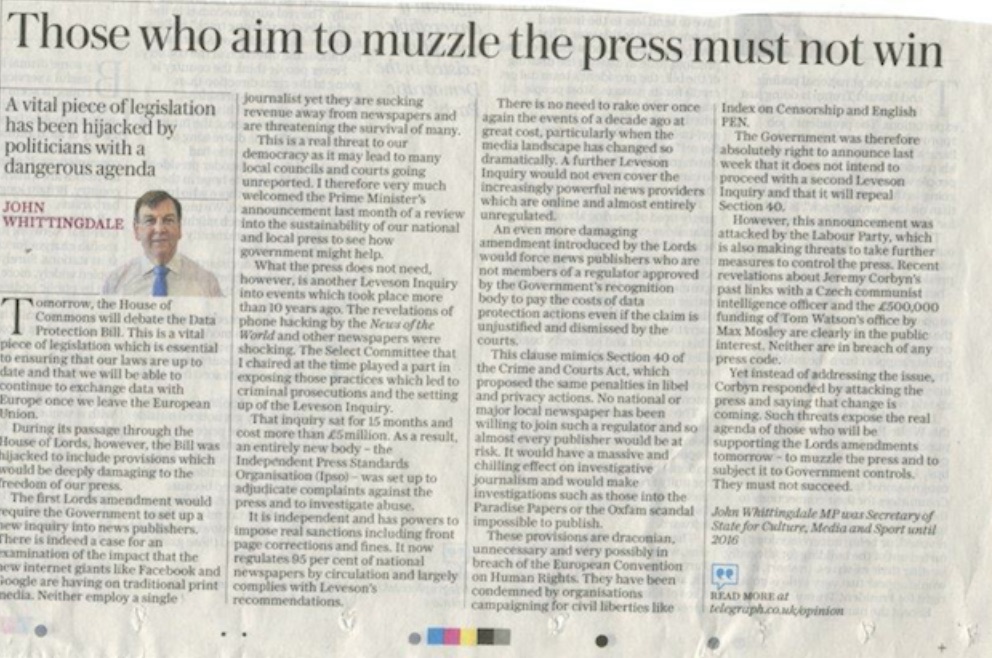
  • Article for the Telegraph on Leveson and the Data Protection Bill
  • Westminster News

Article for the Telegraph on Leveson and the Data Protection Bill

JohnWhittingdale March 5, 2018 3 min read

Tomorrow, the House of Commons will debate the Data Protection Bill. This is a vital piece of legislation which is essential to ensuring that our laws are up to date and that we will be able to continue to exchange data with Europe once we leave the European Union. During its passage through the House of Lords, however, the Bill was hijacked to include provisions which would be deeply damaging to the freedom of our press.

The first Lords amendment would require the Government to set up a new inquiry into news publishers. There is indeed a case for an examination of the impact that the new internet giants like Facebook and Google are having on traditional print media. Neither employ a single journalist yet they are sucking revenue away from newspapers and are threatening the survival of many.

This is a real threat to our democracy as it may lead to many local councils and courts going unreported. I therefore very much welcomed the Prime Minister’s announcement last month of a review into the sustainability of our national and local press to see how government might help.

What the press does not need, however, is another Leveson Inquiry into events which took place more than 10 years ago. The revelations of phone hacking by the News of the World and other newspapers were shocking. The Select Committee that I chaired at the time played a part in exposing those practices which led to criminal prosecutions and the setting up of the Leveson Inquiry.

That inquiry sat for 15 months and cost more than £5 million. As a result, an entirely new body – the Independent Press Standards Organisation (Ipso) – was set up to adjudicate complaints against the press and to investigate abuse.

It is independent and has powers to impose real sanctions including front page corrections and fines. It now regulates 95 per cent of national newspapers by circulation and largely complies with Leveson’s recommendations.

There is no need to rake over once again the events of a decade ago at great cost, particularly when the media landscape has changed so dramatically. A further Leveson inquiry would not even cover the increasingly powerful news providers which are online and almost entirely unregulated.

An even more damaging amendment introduced by the Lords would force news publishers who are not members of a regulator approved by the Government’s recognition body to pay the costs of data protection actions even if the claim is unjustified and dismissed by the courts.

This clause mimics Section 40 of the Crime and Courts Act, which proposed the same penalties in libel and privacy actions. No national or major local newspaper has been willing to join such a regulator and so almost every publisher would be at risk. It would have a massive and chilling effect on investigative journalism and would make investigations such as those into the Paradise Papers or the Oxfam scandal impossible to publish.

These provisions are draconian, unnecessary and very possibly in breach of the European Convention on Human Rights. They have been condemned by organisations campaigning for civil liberties like Index on Censorship and English PEN. The Government was therefore absolutely right to announce last week that it does not intend to proceed with a second Leveson Inquiry and that it will repeal
Section 40.

However, this announcement was attacked by the Labour Party, which is also making threats to take further measures to control the press. Recent revelations about Jeremy Corbyn’s past links with a Czech communist intelligence officer and the £500,000 funding of Tom Watson’s office by Max Mosley are clearly in the public interest. Neither are in breach of any press code.

Yet instead of addressing the issue, Corbyn responded by attacking the press and saying that change is coming. Such threats expose the real agenda of those who will be supporting the Lords amendments tomorrow – to muzzle the press and to subject it to Government controls. They must not succeed.

Continue Reading

Previous: #PassOnPlastic
Next: Pavement parking dangers with Guide Dogs

Related Stories

Meeting with the Police and Crime Commissioner
1 min read
  • Westminster News

Meeting with the Police and Crime Commissioner

November 6, 2025
Sir John Whittingdale meets with Radiotherapy UK
1 min read
  • Westminster News

Sir John Whittingdale meets with Radiotherapy UK

October 28, 2025
Sir John Whittingdale ‘delighted’ at the news of pardon for British Egyptian pro-democracy activist Alaa Abd El Fattah
1 min read
  • Westminster News

Sir John Whittingdale ‘delighted’ at the news of pardon for British Egyptian pro-democracy activist Alaa Abd El Fattah

September 23, 2025

Connect with Us

  • Facebook
  • Twitter
  • Newsletter

Recent Posts

  • Sir John Whittingdale MP poses question about UK-based AI firms
  • G20 and Ukraine
  • Sir John Whittingdale MP speaks on BBC Panorama Edit
  • Meeting with the Police and Crime Commissioner
  • MPs and campaigners discuss local health services
  • Facebook
  • Twitter
  • Newsletter
Copyright © All rights reserved. | MoreNews by AF themes.
We use cookies on our website to give you the most relevant experience by remembering your preferences and repeat visits. By clicking “Accept All”, you consent to the use of ALL the cookies. However, you may visit "Cookie Settings" to provide a controlled consent.
Cookie SettingsAccept All
Manage consent

Privacy Overview

This website uses cookies to improve your experience while you navigate through the website. Out of these, the cookies that are categorized as necessary are stored on your browser as they are essential for the working of basic functionalities of the website. We also use third-party cookies that help us analyze and understand how you use this website. These cookies will be stored in your browser only with your consent. You also have the option to opt-out of these cookies. But opting out of some of these cookies may affect your browsing experience.
Necessary
Always Enabled
Necessary cookies are absolutely essential for the website to function properly. These cookies ensure basic functionalities and security features of the website, anonymously.
CookieDurationDescription
cookielawinfo-checkbox-analytics11 monthsThis cookie is set by GDPR Cookie Consent plugin. The cookie is used to store the user consent for the cookies in the category "Analytics".
cookielawinfo-checkbox-functional11 monthsThe cookie is set by GDPR cookie consent to record the user consent for the cookies in the category "Functional".
cookielawinfo-checkbox-necessary11 monthsThis cookie is set by GDPR Cookie Consent plugin. The cookies is used to store the user consent for the cookies in the category "Necessary".
cookielawinfo-checkbox-others11 monthsThis cookie is set by GDPR Cookie Consent plugin. The cookie is used to store the user consent for the cookies in the category "Other.
cookielawinfo-checkbox-performance11 monthsThis cookie is set by GDPR Cookie Consent plugin. The cookie is used to store the user consent for the cookies in the category "Performance".
viewed_cookie_policy11 monthsThe cookie is set by the GDPR Cookie Consent plugin and is used to store whether or not user has consented to the use of cookies. It does not store any personal data.
Functional
Functional cookies help to perform certain functionalities like sharing the content of the website on social media platforms, collect feedbacks, and other third-party features.
Performance
Performance cookies are used to understand and analyze the key performance indexes of the website which helps in delivering a better user experience for the visitors.
Analytics
Analytical cookies are used to understand how visitors interact with the website. These cookies help provide information on metrics the number of visitors, bounce rate, traffic source, etc.
Advertisement
Advertisement cookies are used to provide visitors with relevant ads and marketing campaigns. These cookies track visitors across websites and collect information to provide customized ads.
Others
Other uncategorized cookies are those that are being analyzed and have not been classified into a category as yet.
SAVE & ACCEPT